
Manufacturing / Crystal
How crystal deal toys are made.
Shape, light and legibility have to work together, from the first drawing to the final polish.
The short answer
Crystal deal toys commonly begin with glass stock that is cut, shaped and polished, then decorated or assembled. Surface printing, surface etching and internal laser engraving are different methods and should be planned for the intended viewing angle.
Be precise about “crystal.”
In the awards industry, “crystal” is a broad commercial term. It should not be treated as proof of a particular composition or optical grade. Ask for the relevant specification instead of relying on a label alone.
For a deal toy, the practical questions are often about clarity, color, edge quality, decoration and construction. I discuss the terminology in more detail in my GRAPHICS PRO article on K9 and optical crystal.
Shape the component and finish the edges.
The design defines the profile, thickness, base and decoration area. Cutting methods may include saws, machining or waterjet work, depending on the geometry and the factory’s process.
On cut shapes, the edges need an acid treatment called pickling. This turns a rough, partly opaque edge into a smooth, mostly clear one. The edges also need polishing to achieve the intended finish. A frosted edge can be an intentional design choice; the finished treatment should be consistent across the piece.
Choose the right decoration method.
Surface etching creates a frosted image on the outside. It can be useful for clear lettering, logos or graphic elements.
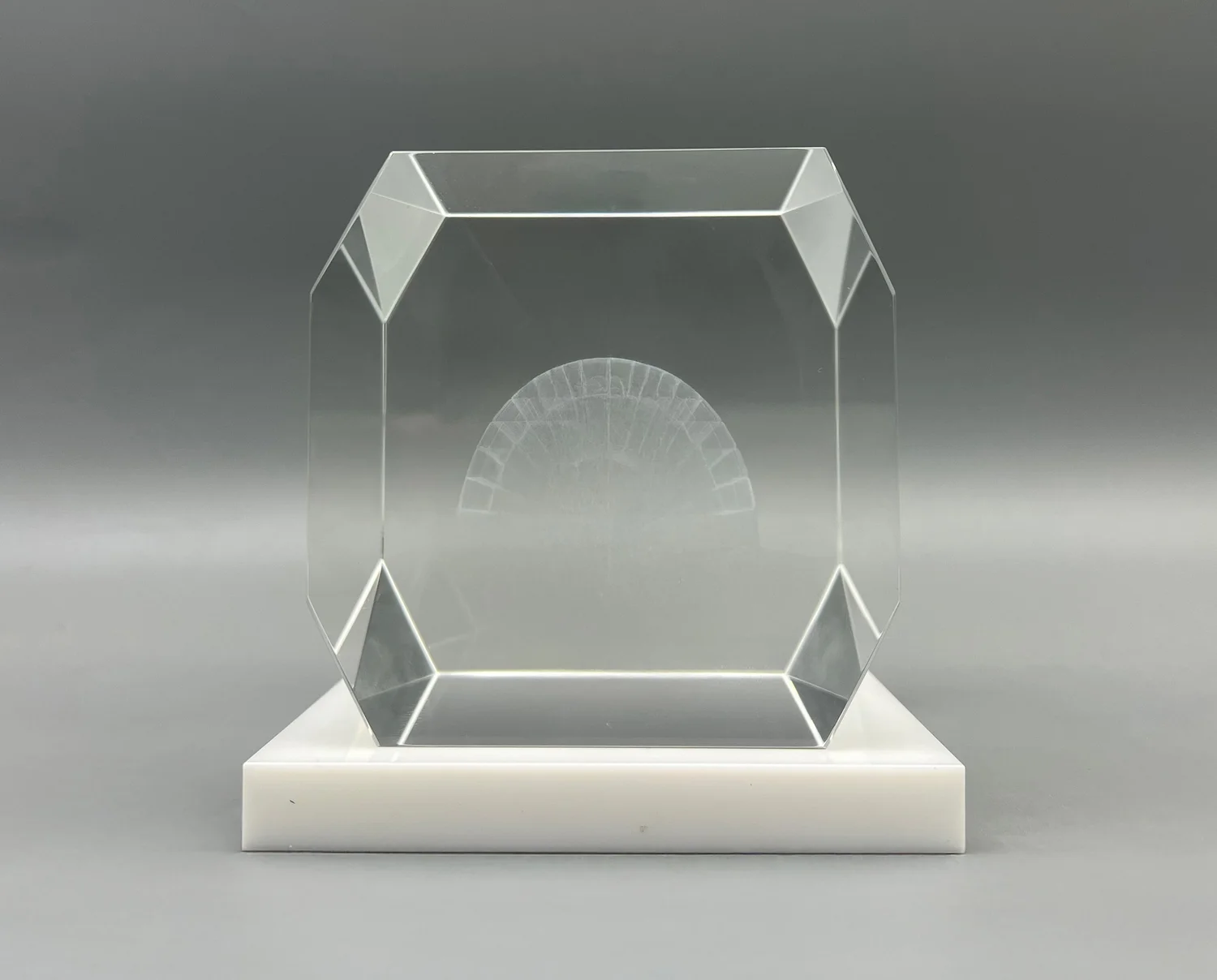
Internal laser engraving creates an image within the material. A three-dimensional subject needs suitable digital preparation and enough space to read clearly from the intended view.
Printing can add color, photographs and gradients. Its position and viewing direction matter, particularly when viewed through the crystal.
Etching with color fill can introduce color into recessed artwork. Fine details and adjacent colors need to be checked against the chosen process.
Design for the actual viewing distance.
Tiny lettering that looks readable on a large monitor may disappear in the finished object. Dense internal imagery can obscure its own detail. Thickness and surrounding surfaces also affect the way the viewer sees the subject.
I want the prototype to answer those questions at the actual size. A three-dimensional image should be judged as a physical image, not only as a digital file.
Check clarity, alignment and protection.
Inspection includes the surfaces and edges, decoration, component alignment and any visible bonding. Packaging must protect corners and prevent parts from contacting one another in transit.
Weight is a practical design consideration too. A substantial piece may need a different base or packing approach from a lighter construction. More weight is not automatically better design.
Questions, answered.
Is 3D laser engraving an object embedded in crystal?
No. The image is created inside the material by laser engraving. It is different from casting acrylic around a physical insert.
Can crystal deal toys include color?
Yes. Printing, color-filled etching and mixed-material components can introduce color, depending on the design.
Does “optical crystal” guarantee a particular grade?
Do not rely on the name alone. Confirm the supplier’s material specification and inspect a representative prototype.
Keep exploring.
Put the ideas to work
Have a deal worth remembering?
Share the achievement, audience, quantity, timing and budget. You do not need a finished concept.
Ask John a question →For commissioned projects, I work with the creative team at Polaris Custom Awards.